
What is MASNS?
Marbach-Schaaf neurodevelopmental syndrome (MASNS; OMIM #619680; ORPHA:692173; NORD) is an ultra-rare genetic disorder that affects the development of the brain. The disease was first described in 2021 and is characterized by global developmental delay with speech delay and behavioral abnormalities, including autism spectrum disorder (ASD) and attention-deficit/hyperactivity disorder (ADHD). Affected individuals also show difficulties in coordination and motor planning, high pain tolerance, overeating, and sleep disturbances. While there is no way to cure the genetic cause of MASNS, early intervention and supportive therapies such as speech, occupational, and physical therapy, as well as behavioral therapy and educational support, can help individuals with MASNS reach their full potential.
How is MASNS diagnosed?
MASNS can only be diagnosed by genetic testing to distinguish it from other neurological disorders with similar clinical presentations. MASNS is caused by mutations in the PRKAR1B gene (OMIM #176911), which encodes the R1β regulatory subunit of cyclic AMP-dependent protein kinase A (PKA). PKA plays a crucial role in turning on/off genes involved in brain development, learning, and memory (among many other functions). Importantly, not all mutations in the PRKAR1B gene are associated with MASNS.
Most initial genetic screening for autism and other disorders does not look at the PRKAR1B gene. Therefore, the majority of cases have been identified through follow-up whole exome sequencing (WES), a large-scale test that looks at all of the genes within the human genome. In many cases, WES is also performed for the parents of an affected individual to determine if the disorder was caused by a de novo mutation in PRKAR1B (i.e., a new mutation that appears in an individual but is not inherited from either parent).
As of February 2026, there have been 57 reported cases of MASNS worldwide. The relatively recent widespread implementation of WES, along with the absence of PRKAR1B on most initial screening panels, suggests that the actual number of people living with MASNS is likely appreciably higher than reported.
More about PRKAR1B/PKA-R1β
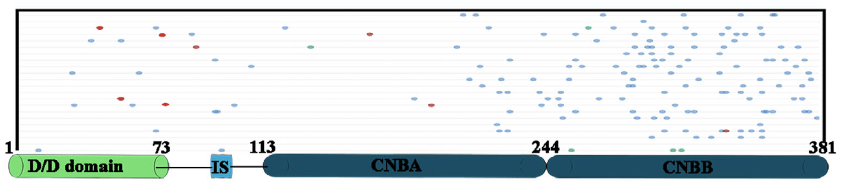
PRKAR1B is the gene that encodes the PKA-R1β protein (sometimes just denoted PRKAR1B). PKA-R1β is composed of a chain of 381 amino acids. Mutations of individual amino acids in this chain can alter how the PKA protein complex functions, and in some cases lead to pathological conditions. Not all mutations in PRKAR1B/PKA-R1β cause MASNS, and some specific mutations are associated with pathologies that are distinct from MASNS. Most MASNS-associated mutations are in the cAMP-binding domains of PKA-R1β (CNBA and CNBB), especially CNBB (see figure above). Of the many PRKAR1B mutations associated with MASNS, the R335W mutation has by far the highest frequency in the patient population.
Click here for a list of research articles relevant to MASNS and PRKAR1B.
